Sabertooth tiger. The young sabertooth tiger was hungry and tired. He wondered why his friend the sun was being mean, burning his eyes and making him thirsty. Back home where the sky was a comfortable grey and the temperature just so, he had followed his nose into a hole in the ground, trailing a delicious odor.
Its allure drew him through miles of dark passageways under a river, through a tingling barrier, and up into daylight onto a hard black surface surrounded by giant trees. He would take a nap in their branches, but first - that big meal. Ahead was the dumpster with its siren scent of discarded taco salads, burgers, chili, grits, sausage gravy and bacon. Oh man.
The young beast leapt lightly into the bin and began to feast, right outside the back door of the Hideaway Café & Curiously Satisfying Breakfast Buffet, one of many fun eateries in the national park's Casino & Entertainment District.
Presently a busboy came out and climbed up the steps to the bin, intent on dumping a full trash bin from satiated lunchtime eaters. Large tawny eyes rose to meet his. He saw a five-foot long, 150-pound wild cat with curving foot-long canine teeth, screamed, dropped the trash bin and fled, slamming the door behind him. The cat started in on the cascade of delicious fresh garbage, thinking maybe soon he should climb into a tree and ponder the edibility of these hairless animals. His family would be proud of him for finding new food.
The above photo was taken on an unnamed road in an unnamed Kentucky national park. Fabulous new hunting grounds for the young sabertooth tiger who had found a hole in the time barrier maintained by the Federal Park Service and Homeland Security.
Wednesday, March 18, 2015
Tuesday, March 17, 2015
Maeve. A thousand years ago or longer, Maeve departed Ireland for the New World...
Maeve. A thousand years ago or longer, Maeve departed Ireland for the New World, after one too many spats with the thickly-settled fairy communities at home. She found all the room she needed in what is now the Southern Tier of New York State, and settled in the uplands there with several close fairy friends. They built an Inn under the lee of a steep hill, planted holly trees and made the area round about homelike and comfortable.
But it was lonely there, and the fairies did not get along with the Iroquois tribes and obnoxious European settlers, many of whom were straight off the boat from Ireland, singing songs that created a deep longing for their older home. By the early 21st century most of her kind had returned to Ireland, leaving Maeve with a few dull, marginal fairies to help her tend her nature kingdom and find the funds and human flesh to pay her regular taxes to the underworld.
In desperation, Maeve began to haunt local bars in Corning and learned that she had a friendly Congressman, and could apply for grants to support her little community. The men who explained these basics of American life to the apparently guileless, black-haired, blue-eyed beauty sometimes did not return to their homes and families. As our story begins, Maeve has hired a local grant writing consultant, young Brian Owen, to help her obtain a community development grant.
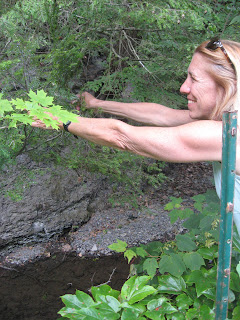
This photo was taken along Goodhue Creek, just off the Great Eastern Trail on the north bank of the Canisteo River, near Addison NY. Maeve's community is not far away.
But it was lonely there, and the fairies did not get along with the Iroquois tribes and obnoxious European settlers, many of whom were straight off the boat from Ireland, singing songs that created a deep longing for their older home. By the early 21st century most of her kind had returned to Ireland, leaving Maeve with a few dull, marginal fairies to help her tend her nature kingdom and find the funds and human flesh to pay her regular taxes to the underworld.
In desperation, Maeve began to haunt local bars in Corning and learned that she had a friendly Congressman, and could apply for grants to support her little community. The men who explained these basics of American life to the apparently guileless, black-haired, blue-eyed beauty sometimes did not return to their homes and families. As our story begins, Maeve has hired a local grant writing consultant, young Brian Owen, to help her obtain a community development grant.
This photo was taken along Goodhue Creek, just off the Great Eastern Trail on the north bank of the Canisteo River, near Addison NY. Maeve's community is not far away.
Monday, March 16, 2015
Introducing Ten Thousand Secrets National Park, a science fiction fairy tale embedded in present-day US politics.
In this slightly altered present, casinos and gas fracking wells pay for our national parks, and a Kentucky senator rallies his bad-ass allies to update our nation's proud military heritage.
Will science survive? Can we ignore the Grandfather Paradox of time travel and get away with it? What's Brian's mom up to now? Which of the many secrets would you want to explore?
I'll share excerpts and images here while embarking on the grueling process of publishing this novel of fast-paced adventure-fairy tale-ecofiction. If you accept the presence of swear words, plot-appropriate mayhem, and delicate hints of off-stage romance, the book is enjoyable for adults and older kids.
The photo of young woodlands comes from Kentucky's Little Barren River valley, just east of a famous national park. In this story the government has re-named it Ten Thousand Secrets National Park Casino & Entertainment District, to attract a more diverse, bigger-spending clientele.
Monday, December 23, 2013
A better nutcracker: Black walnuts and hickory nuts galore
Nuts are healthful, and available by gathering them into a bag as we walk in the woods or along pasture edges.
To shell the nuts easily, if you don't have access to workshop tools, vices, grips and the like, you need one of the super-strong, expressly designed nutcrackers available via a google search (see photo - around $50).
Now I will be less dependent on watching for supermarket "specials" on the price of English walnuts. Black walnuts are famed for their rich flavor and go for very high prices in the market place. A big thank you to my family for helping me bring the price waaaaaay down.
Woodland riches are free for the gathering. Watch for future posts on my recent adventures with black walnuts, shagbark hickory nuts, beech nuts, beech sprouts and more.
Friday, November 22, 2013
Jackie Kennedy's condolence thank-you cards - one came to me
On November 22, 1963 I was 11 years old. I remember where I was when I heard the news, of course, and subsequently was watching live black and white TV when Oswald was shot by Jack Ruby. During these days I asked my mom what I could do, and she suggested that I send a letter of condolence to Jacqueline Kennedy.I promptly wrote and sent the letter. Its contents are no doubt lost to history, but I saved the response I received in March 1964, after the Beatles had arrived in America and the world was rapidly changing beyond belief from those dark November days.
The black-rimmed card reads "Mrs. Kennedy is deeply appreciative of your sympathy and grateful for your thoughtfulness." The accompanying card has her signature on the upper front right-hand corner in place of a stamp, my name and address written in exquisite calligraphy in ink, and her married name printed across the back flap.
My newly-12 year old self also saved the March 18, 1964 New York Times article, "Shamrock is left at Kennedy grave," describing Mrs. Kennedy's visit to her husband's grave on St. Patrick's Day, and announcing "Mrs. Kennedy chose today as the "appropriate" time to acknowledge the messages of sympathy she received after her husband's death. She mailed 900,000 black-bordered prayer cards and letters"....the article adds that 2000 volunteers had been working since the previous December to open and sort the letters; that 1000 per day were still arriving at the White House; that the signature-franked letters had been distributed over a week's time to avoid post office overload.-- Hilary Lambert November 22, 2013
Sunday, July 22, 2012
Grape leaves are ready by June to make dolmas
Yep you don’t have to buy them at the $7.89 per half lb
olive bar, you can make them yourself. I used to buy jars of preserved grape
leaves, but this is more fun. I first posted about dolmas using wild grape leaves late
last August http://www.backinthecaragain.blogspot.com/2011/08/wild-grapes-their-leaves.html,
but by then the leaves are a tad leathery and not so succulent when cooked. So grab
‘em young (a good motto generally!). They are still fine in late July – I harvested
a bunch on July 21 on the high ground above Fall Creek off Freese Road. The
local hipster enviro camp counselors seem to be using the “forked dragon’s
tongue” characteristic of the grape vine’s growing tendrils to help little kids
identify this plant but heck, it’s just grape leaves, eh?! (other motto: “What could
possibly go wrong?”).
Anticipating a gluten free vegan crowd at the solstice
party, I grabbed my ancient trusty “Middle Eastern Cookery” by Eva Zane (101
Productions, San Francisco, 1974) and went with her “Basics” dolmas stuffing recipe:
1
cup (white) rice soaked in cold water and drained.
1
cup finely minced green onions or 1 cup grated onion (me, 1 cup roughly chopped
onion).
3 T
minced (fresh, please) parsley.
2 T
fresh chopped dill.
2
garlic cloves (Zane sez “optional,” I say “Nonsense”)
½ tsp
allspice
Salt
and pepper to taste.
Stir
this all up. Place a grape leaf on towel or counter or plate (“dull side” up –
I could not discern a dull side; they both work). Place 1 – 3 tsp of filling on
the leaf (depends on the size of the leaf). Here are the directions I cannot
seem to fully comply with: “Fold end of leaf over to cover filling, fold sides
in and starting at stem end, roll carefully to form a firm cylinder about 2
inches long, depending on size of leaf.” My firm cylinders look more like tiny envelopes,
but they work just fine. Do this for all the grape leaves, eh?
You
may have leftover stuffing. I cooked it in a saucepan w/added water and served as
a side dish with certified gluten free tortilla chips and it was wolfed, reckon
that should be deered, down.
Spread
the “reserved” leaves on the bottom of a heavy saucepan, place the dolmas side
by side across the bottom, then stack them up until all are, well, ya know, in
place (my recipe lingo falters occasionally, here because I am way too self
conscious about that foodie term “reserve”).
Sprinkle
the layers with lemon juice if you have it. Add 1 cup water or stock (I added more
as needed while it cooked – don’t want the dolmas to scorch), 3 T olive oil,
and cover with a heavy plate, saucer or other simmer-proof item, to prevent the
dolmas from unfolding while cooking. Cover and simmer over low heat, checking
frequently, for about 1 hour. Test for tenderness (eat one). Remove from pan,
cool, and place on a serving platter, garnish with parsley sprigs and lemon
wedges if you got em. Serve with bowl of chilled yogurt (plain not
sweetened), or not. They will all be eaten quickly.
Monday, July 9, 2012
Quick Fixes and the Sustainable Long Haul: Hemlock Woolly Adelgid, Hydrilla and Our Watershed
Quick Fixes and the Sustainable
Long Haul
Hemlock
Woolly Adelgid, Hydrilla and Our Watershed
Forthcoming in Network News 2/12, newsletter of the Cayuga Lake Watershed Network www.cayugalake.org. Thanks to Mark C. Whitmore and Judy Abrams for editorial assistance.
Hilary Lambert, Steward
In the winter 2011 issue of Network News, our lead article stressed
the need to work toward a sustainable energy future for the Finger Lakes, in
the face of a rapidly warming climate. The choices we make and paths that we
follow in the near future will determine the long-term fate of the clean and
plentiful water our region (and the Great Lakes) is presently known for.
The Cayuga Lake Watershed Network Board of
Directors’ actions and Network programs increasingly stress the interdependence of
clean water and energy choices. The Network’s 2011 Strategic Plan includes the goal of “supporting
new and ongoing successful collaborative projects with short and long-term
impacts on maintaining and improving the lake, its tributary creeks, and the
watershed,” by “helping communities prepare for climate change impacts.” Further,
in May of 2012, the Board voted to approve a “Position Statement on
Hydraulic Fracturing,” stating that “We
oppose the continuation of hydraulic fracturing and urge immediate emphasis on
an energy policy that promotes conservation and renewable energy sources."
Early symptoms of
climate change are extreme weather events and the movement of species into
regions where they previously could not survive. The invasive species presently
bedeviling Cayuga Inlet in Ithaca, Hydrilla
verticillata, is from temperate latitudes similar to ours in Korea, and
survives well in northern climates: it is not a true climate change opportunist.
However, part of the Hydrilla Task Force’s initial response strategy was the
hope that a cold winter would kill off plants established in shallow waters.
Instead, the mild (or “missing”) winter of 2011-12 helped hydrilla survive and
prosper. As with the Asian Clam infestation in Owasco Lake to the east, this
apparently “new normal” weather benefits the spread of these aquatic invasive
species.
For information
about the excellent long-term eradication program developed by the Hydrilla
Task Force of the Cayuga Lake Watershed, information about possible impacts of
herbicide use, and “everything” hydrilla: http://www.StopHydrilla.org. To sign up as a Hydrilla
Hunter, contact: ambismb@gmail.com.
Another
aggressive invasive – this one attacking the hemlocks in our gorges – is the
aphid-like Hemlock Woolly Adelgid (Adelges
tsugae, aka HWA). A true climate change opportunist, HWA has been making
its way north for decades with terrible destructive force, sucking the life out
of majestic old hemlock stands in the southern mountains and valleys, and
turning the hemlock stands in New Jersey’s wilder places and Pennsylvania’s
uplands into brown skeletons (maps: http://na.fs.fed.us/fhp/hwa/maps/distribution.shtm).
Cornell’s Mark
Whitmore is a forest ecologist and nationally-recognized expert on HWA, which
first appeared in the Finger Lakes area of New York State in 2008. He has been
mapping its spread and advising on limiting its immediate impacts, and is also
concerned about the Emerald Ash Borer’s potential for ecosystem
destruction/transformation, in this period of rapid climate change.
Why is HWA a
problem? Most obviously, it destroys one of our most beautiful, evocative
trees. In ecosystem terms, hemlocks are a keystone species for our cool creeks
and their biodiversity. If hemlocks die, creeks will be exposed to the sun and
warm up, and steep shale banks will erode and collapse, altering creek habitat
and sending warmer, turbid waters to Cayuga Lake.
In 2009, HWA was found on
hemlocks in Cornell University’s Cascadilla Gorge and around Beebe Lake. In
response, a collaborative project, involving Cornell Plantations, Cornell’s
Department of Natural Resources and Mark Whitmore, was organized to track and
where possible mitigate HWA impacts. A trained group of citizen-stewards carry
out regular monitoring for the spread of HWA in Six Mile Creek, Edwards Lake
Cliffs, Fall Creek, Fisher Old Growth, Lick Brook, Steep Hollow, and Coy Glen.
This local effort is part of a larger project, led by Whitmore, to meet the
challenge of invasives by increasing stakeholder knowledge and involvement.
That means you! Learn more and get involved via the Cornell Plantations
invasive species web pages: http://www.cornellplantations.org/our-gardens/natural-areas/invasive
The non-winter of 2011-12 may
be responsible for a sudden leap of HWA along
Cayuga Lake’s western shoreline. In 2011, the infestation was mapped as individual
infested trees and small stands, in the Glenwood Pines area along the
southwestern Cayuga Lake shoreline. Not so any longer.
In early July
2012, Judy Abrams noticed something wrong with a big hemlock that holds down
the banks of a steep shaley creek on her lakeshore property, several miles
north of the Glenwood area. She learned that the tree was infested with HWA,
and soon realized that all of her estimated 200 hemlocks are infested or will
be soon. Judy called neighbors to the south, toward Glenwood – they have it
too. A quick check revealed that it is present in hemlocks on all their
properties.
| Lakeside landowner Judy Abrams and affected hemlock tree. Note the creek it shades, and steep shaley banks it stabilizes. |
As with hydrilla,
the immediate, short-term management options for HWA include insecticides – infested
hemlock trees can be protected individually with chemical insecticides. Cultural
practices can also slow impacts; biological control agents are under study (Fact
Sheet, Early Detection of the Hemlock
Woolly Adelgid (Adelges
tsugae) in Small Northeastern Hemlock (Tsuga canadensis) Woodlots, www.ForestConnect.info).
Here we arrive at
the question of the sustainable long haul mentioned in the title. Herbicides
and pesticides applied over several years will have adverse impacts on Cayuga
Inlet, and on our gorges and their creeks. The potential for homeowner misuse
of currently registered soil drench pesticides and subsequent environmental
contamination (proximity of streams) is great. Professional applications pose
far fewer risks and can help save the local genotypes of hemlocks. However,
maintaining the current habitats with pesticides is untenable for the long run.
We’ve got to continue to develop biocontrol and tree resistance. Experts like
Whitmore and the Hydrilla Task Force know this; monitoring of impacts from treatment
programs is standard (although underfunded, in the case of hydrilla).
So, what about
the sustainable long haul? In a situation of rapid climate change, when do we
let the hemlocks go? Long-term, can we really prevent the takeover of our lakes
by green mats of suffocating hydrilla, and impacts from other invasives
steadily wending their way into warming places? Beyond the next few years, can
we realistically expect to keep our cool creeks and clear waters?
A 2011 study
reports that, by 2100, “global climate change
will modify plant communities covering almost half of Earth's land surface and
will drive the conversion of nearly 40 percent of land-based ecosystems from
one major ecological community type -- such as forest, grassland or tundra --
toward another.” The study further states that the rapidity of change “will disrupt the ecological balance between interdependent and
often endangered plant and animal species, reduce biodiversity and adversely
affect Earth's water, energy, carbon and other element cycles” (NASA/Jet
Propulsion Laboratory 2011, December 18. Climate change may bring big ecosystem
shifts, NASA says. ScienceDaily;
Jon C. Bergengren, Duane E. Waliser, Yuk L. Yung. Ecological sensitivity: a
biospheric view of climate change. Climatic
Change, 2011; 107 (3-4): 433 DOI:10.1007/s10584-011-0065-1).
This is not good
news for the future of our favorite places, plants, animals, and water
resources. We can ignore this freight train coming at us; we can say “It won’t
happen until after I’m gone” – or we can begin to think and plan ahead in a
meaningful way, that can lead to an increasingly different, eventually
transformed – but healthy, sustainable – landscape and life for our
descendants.
Locally, the Tompkins County
Climate Protection Initiative (http://www.tccpi.org/) is already looking ahead. Their
mission: “We are committed to helping Tompkins County achieve a dynamic
economy, healthy environment, and resilient community through a focus on energy
efficiency and renewable energy.” Their programs need everyone’s support
to reduce greenhouse gas emissions locally, the results to serve as a template
for other local communities. As with
banning fracking one town at a time (www.cedclaw.org ), perhaps we can slow this
freight train down, one locale at a time.
Let’s keep talking, thinking, and being creative. The quick fixes are good for what ails us right now; the sustainable long haul is necessary for what comes after us.
Here is what landowner Judy Abrams is doing right now, with an eye on the sustainable long haul: "I was horrified that all the hemlocks on my property were infected with HWA and relieved to learn from Mark Whitmore that even trees near death can recover if treated properly. Because the insecticide is an imicloprid product I weighed the consequences: untreated, badly infected trees last a year or two; less affected trees live up to 4 years. If my 200 hemlocks die, my beautiful gorge would be denuded, and the cliffside and driveway would erode. The insecticide is toxic to bees, but is painted on trunks and absorbed. This treatment plus slow release pellets later protects trees up to 7 years, and by then there may be natural control methods. On Mark's advice, I hired White Oak Nursery in Geneva. The cost of saving 200 hemlocks is less than the cost of removing two large dead trees."
To find out more about climate
change, looming impacts, and what can be done, consult these sources:
http://environment.yale.edu/climate/about/ - Yale Project on Climate
Change Communication;
http://climateaccess.org - The network for those
engaging the public in the transformation to low-carbon, resilient communities;
http://climatecentral.org Climate central: why climate
change matters.
Subscribe to:
Posts (Atom)